
growth
What To Look For Before Choosing Sales Software For A Growing Business
The best sales software for a growing seller is not the one with the longest feature list. It is the one that fits the operating pressure the business is actually under.
Updated October 5, 2026
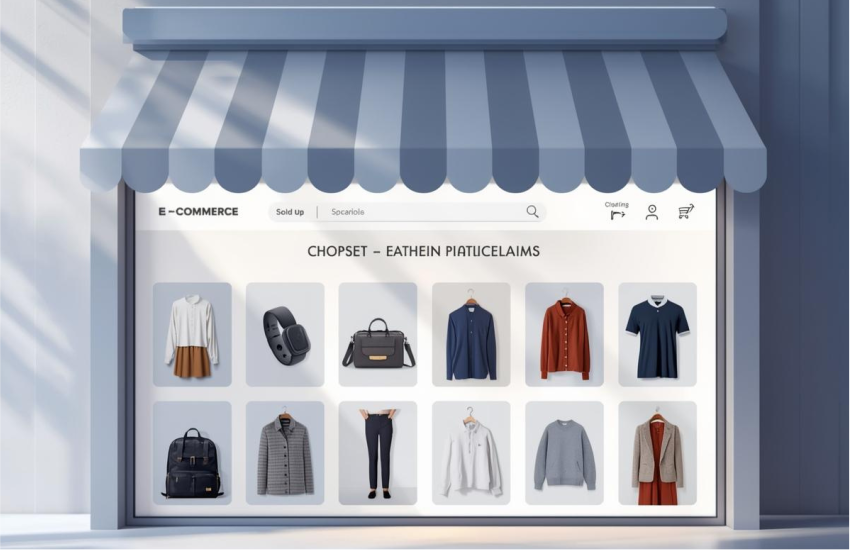
Choosing sales software is not just a feature comparison. It is a decision about how the business will run when more customers, products, orders, and staff members enter the picture.
A simple tool can be perfect at the beginning. The same tool can become expensive later if it forces the owner to keep stitching the business together manually.
Start With The Operating Pressure
Before comparing tools, name the pressure the business is feeling.
- Are orders being missed or duplicated?
- Are customers hard to follow up with?
- Are staff members unclear on ownership?
- Is inventory trust becoming a problem?
- Are campaigns bringing interest that the team cannot convert cleanly?
- Is the owner still needed for every small operational decision?
The right tool should reduce the pressure that is actually slowing the business down.
Look Beyond The Storefront
A storefront is important, but a growing seller usually needs more than a beautiful product page.
The team also needs a way to manage what happens after interest turns into action. That includes order status, customer history, staff roles, product availability, finance visibility, and the ability to learn from sales patterns.
If software only helps customers browse, but leaves the seller to coordinate everything manually afterward, the business still carries a hidden operational cost.
Check Whether The Tool Supports Teamwork
A business that depends on one owner remembering everything is fragile.
Good sales software should help the team share responsibility without losing context. Staff accounts, assignments, roles, order notes, customer records, and performance visibility all matter because they move the business away from memory-based operations.
A growing seller does not just need more sales. They need a way for more people to handle sales without creating more confusion.
Understand The Customer Record
Customer information should become more valuable over time.
Look for software that can help the business understand repeat buyers, incomplete orders, support history, campaign response, and follow-up opportunities. If every customer interaction disappears into a chat thread, the seller has to keep rediscovering the same information.
CRM should help the team act with memory.
Think About Payments And Trust
Customers buy faster when the buying experience feels clear and reliable.
That means the software should support payment clarity, order status, fulfillment confidence, and communication that reduces uncertainty. Trust is not only a branding issue. It is an operational issue.
When the system helps the team respond quickly and accurately, customers feel it.
The SalesGee Lens
SalesGee is built around a simple belief: serious sellers need an operating system, not another disconnected surface.
That means the product direction keeps storefronts, CRM, order management, product operations, staff workflows, payments, campaigns, and reporting close together.
The point is not to overwhelm sellers with software. The point is to help the business become easier to understand as it grows.
A Practical Test
Before choosing any sales software, ask:
- Will this help us handle more orders with less confusion?
- Will it make customer history easier to use?
- Will it help the team share work responsibly?
- Will it make inventory and product decisions clearer?
- Will it support the kind of growth we are already moving toward?
If the answer is yes, the tool is not just managing sales. It is strengthening the business behind the sales.
Discussion
Comments
Add a public note on What To Look For Before Choosing Sales Software For A Growing Business.